Trade promotions continue to be one of the largest investments made by consumer packaged goods (CPG) companies. From retailer incentives and temporary price reductions to display programs and co-marketing initiatives, organizations dedicate significant resources to increasing sales and strengthening retail partnerships.
Yet many businesses still struggle to answer one fundamental question:
Did the promotion actually deliver value?
In 2026, successful CPG manufacturers and suppliers are shifting their focus from simply executing promotions to measuring their effectiveness. By tracking the right key performance indicators (KPIs), organizations can optimize future investments, improve retailer collaboration, and maximize promotional return on investment (ROI).
Why Measuring Trade Promotion Effectiveness Matters
Trade promotions are designed to drive sales, increase product visibility, and strengthen retailer relationships. However, without meaningful performance measurement, organizations risk investing in programs that generate little long-term value.
Effective measurement helps businesses:
- Understand promotional ROI
- Identify successful retail programs
- Improve future planning
- Optimize trade spend
- Strengthen retailer collaboration
- Support data-driven decision-making
Rather than relying on assumptions, CPG teams can use measurable results to guide future investments.
The Most Important Trade Promotion KPIs
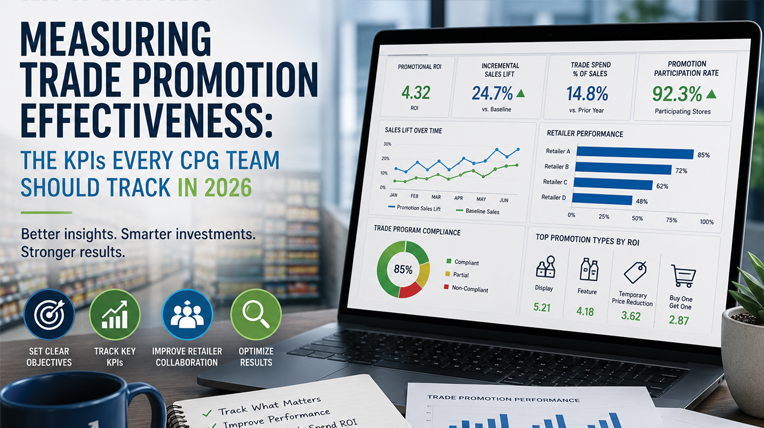
Promotional ROI
Promotional return on investment remains one of the most important metrics for evaluating trade programs.
This KPI compares the revenue generated from a promotion against the total promotional investment.
Monitoring ROI helps organizations identify:
- High-performing promotions
- Low-performing campaigns
- Opportunities to improve future investments
Incremental Sales Lift
Not all sales generated during a promotion are incremental.
Incremental sales lift measures the additional revenue directly attributed to a promotion beyond normal sales levels.
Understanding incremental sales helps determine whether a promotion actually influenced purchasing behavior.
Trade Spend as a Percentage of Sales
Trade spend should always be evaluated alongside revenue.
Monitoring trade spend as a percentage of sales helps organizations understand whether promotional investments remain aligned with business objectives.
Large increases in trade spending without proportional sales growth may indicate opportunities for optimization.
Retailer Performance
Not every retail partner delivers the same results.
Comparing retailer performance allows CPG suppliers to understand:
- Which retailers consistently outperform expectations
- Which promotional programs generate the strongest results
- Where additional support may be needed
This information supports stronger retailer conversations and better joint business planning.
Promotion Participation Rates
Understanding how many participating retailers successfully executed a promotion provides valuable insight into program adoption.
Higher participation often leads to stronger category performance and broader consumer visibility.
Trade Program Compliance
Execution matters.
Even the best promotion cannot deliver results if agreed-upon activities are not completed.
Monitoring compliance metrics helps organizations evaluate:
- Promotion execution
- Display compliance
- Pricing compliance
- Program participation
- Retailer adherence
Why Business Intelligence Improves Trade Promotion Performance
Modern organizations increasingly rely on business intelligence to monitor promotional performance.
Interactive dashboards make it easier to identify trends, compare retailers, evaluate historical performance, and uncover opportunities for improvement.
Business intelligence supports:
- Faster reporting
- Better forecasting
- Improved retailer scorecards
- More informed promotional planning
Read our related article:
<a href=”https://infobate.com/how-business-intelligence-improves-cpg-performance-2026/”>How Business Intelligence Improves CPG Performance in 2026</a>
Building Better Trade Promotion Strategies
Successful organizations don’t simply review promotional performance after programs end.
Instead, they continuously evaluate results throughout the year to improve future planning.
Best practices include:
- Establishing consistent KPIs
- Reviewing retailer performance regularly
- Comparing historical promotions
- Monitoring promotional ROI
- Aligning promotions with strategic objectives
- Sharing performance insights across teams
Continuous improvement leads to stronger long-term performance.
Frequently Asked Questions
What is trade promotion effectiveness?
Trade promotion effectiveness measures how successfully promotional investments achieve business objectives such as increasing sales, improving retailer engagement, or strengthening profitability.
What KPIs should be used to measure trade promotions?
Common KPIs include promotional ROI, incremental sales lift, trade spend as a percentage of sales, retailer performance, compliance rates, participation rates, and promotional profitability.
Why is promotional ROI important?
Promotional ROI helps organizations determine whether trade investments generated sufficient financial returns and identify opportunities for optimization.
How does business intelligence improve trade promotions?
Business intelligence provides visibility into promotional performance, helping organizations analyze results, compare retailers, identify trends, and improve future planning.
Why should retailer performance be measured?
Not every retailer produces the same outcomes. Measuring retailer performance helps suppliers improve collaboration, optimize investments, and strengthen long-term partnerships.
Looking Ahead
Trade promotions will continue to play a significant role in CPG growth strategies throughout 2026.
Organizations that consistently measure promotional performance, monitor meaningful KPIs, and use data to guide future investments will be better positioned to improve retailer relationships, optimize trade spend, and increase profitability.
The most successful CPG companies won’t simply run more promotions—they’ll run smarter ones.