
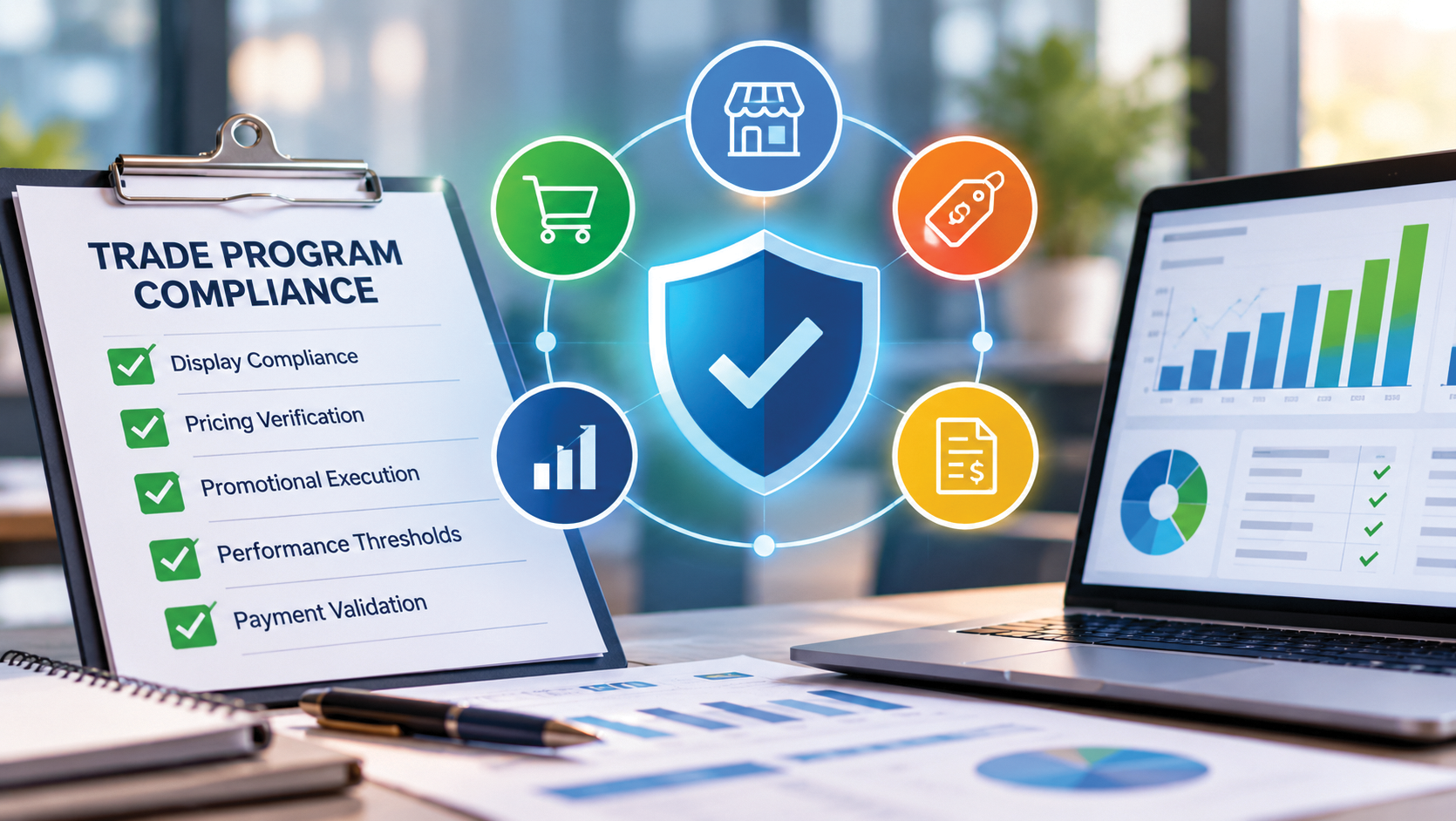
Trade program compliance rarely gets the attention it deserves until something goes wrong — an audit reveals deductions that were never verified, or a retailer disputes a chargeback the manufacturer can’t defend with data. Building a proactive compliance process, rather than reacting after the fact, is one of the most underrated ways CPG companies can reduce financial risk.
The Compliance Risk Hiding in Trade Programs
Every trade program comes with terms: a display that should go up by a certain date, a price reduction that should scan correctly for a defined period, a performance threshold that should be met before a rebate is paid. When compliance with these terms isn’t verified, manufacturers end up paying for promotions that didn’t happen as agreed — and have little recourse when disputes arise.
Common Compliance Gaps
The most common gaps show up in three places: displays or promotional activity that was never confirmed in-store, price reductions that were approved but never verified at the register, and performance-based payments that get issued automatically without checking whether the underlying performance threshold was actually met.
Building a Compliance Monitoring Process
Closing these gaps starts with connecting trade program terms directly to retail execution data — verifying that a display went up, a price change registered, or a volume threshold was hit before payment is triggered. Even a lightweight monitoring process, applied consistently, catches the majority of compliance issues before they turn into disputes.
From Risk Reduction to Real ROI
Beyond reducing risk, strong compliance monitoring has a second benefit: it makes trade spend evaluation possible in the first place. A manufacturer can’t accurately measure whether a promotion drove incremental sales if it can’t first confirm the promotion actually ran as planned.
Trade program compliance isn’t just a defensive measure against disputes and audits — it’s the foundation that makes accurate trade spend evaluation possible. Companies that build strong compliance monitoring protect their margin twice over.
InfoBate connects trade program terms to real retail execution data, giving CPG companies a clear, defensible compliance record for every promotion and payment.
Frequently Asked Questions
Q: What is trade program compliance?
A: Trade program compliance refers to verifying that the terms of a promotional agreement — such as displays, price reductions, or performance thresholds — were actually met before payments or rebates are issued.
Q: What are the most common trade compliance gaps?
A: The most common gaps are unverified in-store displays, price reductions that were approved but never confirmed at the register, and performance-based payments issued without checking whether the performance target was actually met.
Q: How does better compliance monitoring reduce financial risk?
A: By verifying compliance before payment, manufacturers avoid paying for promotions that didn’t happen as agreed and have a defensible record to resolve disputes with retailers or auditors.