Consumer packaged goods manufacturers generate enormous amounts of information across distributors, retailers, products, promotions, territories, and individual store locations.
The challenge is not getting more data.
The challenge is gaining enough visibility into that data to understand what is happening, where it is happening, and what action should come next.
In 2026, operational visibility is becoming increasingly important for CPG manufacturers seeking to improve sales performance, strengthen distributor and retailer relationships, identify growth opportunities, and make faster business decisions.
When manufacturers can see performance at the product, distributor, retailer, geographic, and store levels, data becomes much more than a reporting tool. It becomes a foundation for action.
What Is Operational Visibility for CPG Manufacturers?
Operational visibility is the ability to clearly understand performance across the different areas that influence a CPG business.
That can include visibility into:
- Product sales
- Distributor performance
- Retailer performance
- Store-level sales
- Product distribution
- Trade promotion performance
- Program compliance
- Geographic trends
- Historical sales performance
- Product voids and out-of-stock opportunities
Instead of evaluating these areas independently, stronger visibility helps manufacturers understand how they relate to one another.
A product may be performing well nationally while struggling in a specific region. A distributor may generate strong overall sales while leaving significant distribution opportunities within certain retailers. A promotion may appear successful at the aggregate level while underperforming at specific locations.
Greater visibility helps reveal these differences.
Why CPG Operational Visibility Matters
Broad sales totals can tell manufacturers whether revenue increased or decreased.
They do not always explain why.
To make better decisions, manufacturers need enough detail to understand the factors behind performance.
Operational visibility can help answer questions such as:
- Which products are generating the strongest growth?
- Which distributors are producing the best results?
- Where are products underrepresented?
- Which stores represent untapped sales opportunities?
- Which promotions are producing incremental growth?
- Where are program execution problems occurring?
- Which regions are gaining or losing momentum?
Answering these questions allows teams to move from reporting results to actively improving them.
Start With Store-Level Sales Visibility
Store-level information is one of the most valuable sources of insight available to CPG manufacturers.
Aggregate reporting can hide significant differences between individual locations.
For example, a product might perform strongly across a retailer overall, but closer analysis could reveal that most of those sales come from only a portion of the retailer’s locations.
That creates an important question:
What is different about the remaining stores?
Store-level analysis can help identify:
- Distribution gaps
- Product voids
- Underperforming locations
- High-performing stores
- Regional differences
- Potential out-of-stock situations
- New placement opportunities
These insights give manufacturers a more precise view of where to focus sales and retail execution efforts.
Identify Product Distribution Opportunities
Distribution is a fundamental driver of CPG sales.
Even a high-performing product cannot generate its full potential if it is unavailable in locations where consumers are likely to purchase it.
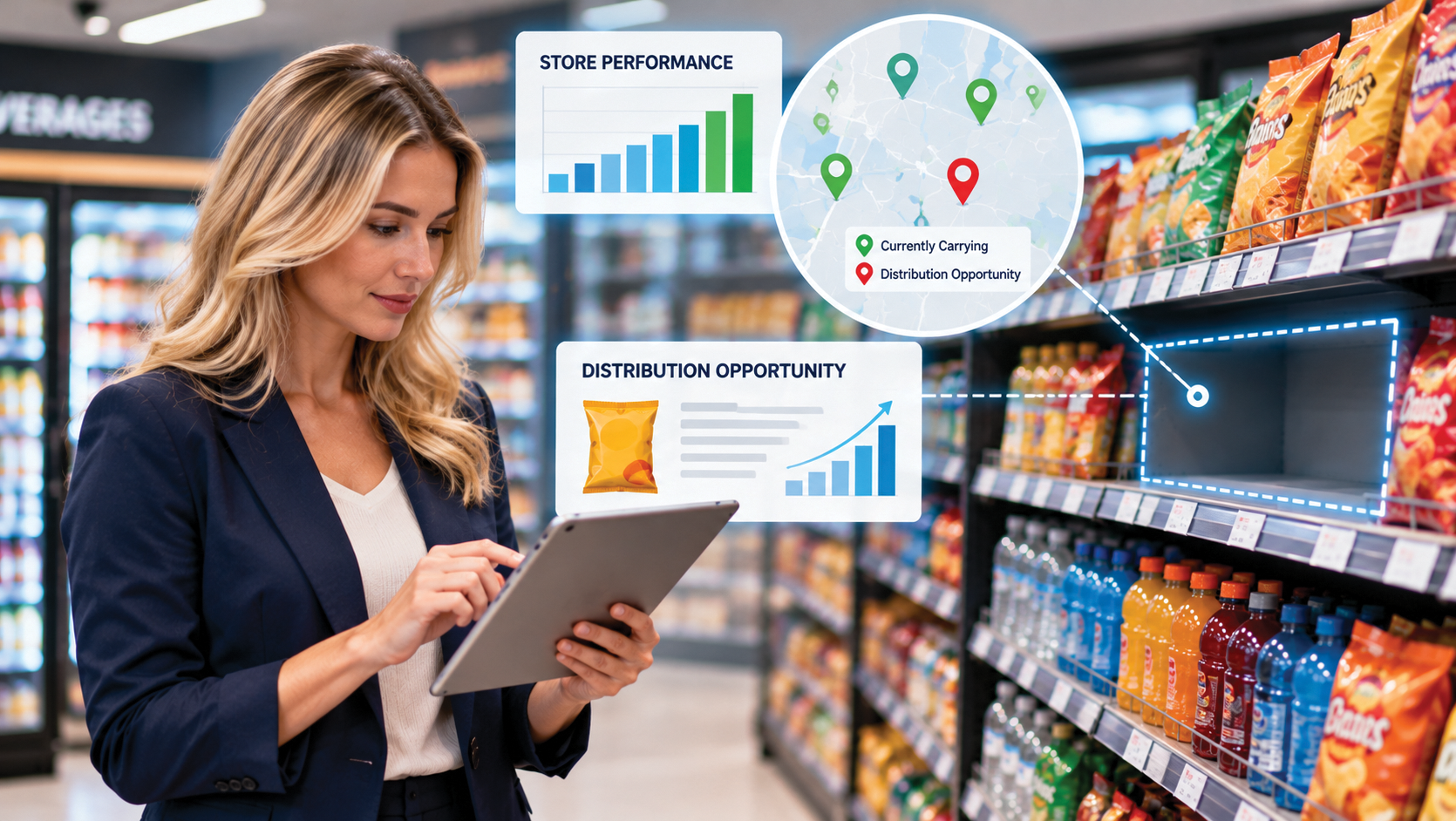
Manufacturers can compare sales and distribution information to identify stores, retailers, or territories where a product has room to expand.
A strong distribution analysis should help teams identify:
- Stores currently carrying a product
- Locations where the product is absent
- Similar stores where the product performs well
- Markets with strong category demand
- Distributors with potential expansion opportunities
This transforms distribution planning from a broad expansion strategy into a more targeted growth initiative.
Compare Distributor Performance
Distributors play a critical role in bringing CPG products to market.
Manufacturers need visibility into how distributors perform across products, customers, territories, and programs.
Comparative distributor analysis can reveal:
- Sales growth by distributor
- Distribution gains
- Product mix
- Retailer coverage
- Program participation
- Regional performance
The objective is not simply to rank distributors.
It is to understand where each partner is succeeding and where additional opportunities may exist.
These insights can support more productive distributor reviews and better resource allocation.
Connect Trade Promotion Data With Sales Results
Trade promotions should not be evaluated separately from sales performance.
Manufacturers need visibility into both program execution and business results.
Connecting these data points can help teams evaluate:
- Promotional sales lift
- Incremental revenue
- Retailer participation
- Program compliance
- Promotional ROI
- Performance by store
- Performance by distributor
This helps manufacturers distinguish between programs that generate measurable growth and programs that primarily shift the timing of existing sales.
For additional insight, read Measuring Trade Promotion Effectiveness: The KPIs Every CPG Team Should Track in 2026.
Monitor Trade Program Compliance
A promotional strategy is only as effective as its execution.
Manufacturers may negotiate pricing, placement, displays, participation requirements, or other program conditions with retail partners.
If those requirements are not fulfilled, expected results may never materialize.
Operational visibility should therefore include compliance measures such as:
- Retailer participation
- Display execution
- Pricing compliance
- Product placement
- Program timing
- Promotional performance
Better compliance visibility helps manufacturers identify execution issues earlier and protect trade investments.
Learn more in Why Trade Program Compliance Matters More Than Ever in 2026.
Use Historical Sales Data for Context
Current sales performance tells manufacturers what is happening now.
Historical data helps explain whether that performance is unusual.
Comparing weeks, months, quarters, and years can reveal:
- Seasonal purchasing patterns
- Long-term product growth
- Recurring promotional trends
- Regional demand changes
- Distributor performance patterns
- Changes in retailer performance
Historical context can prevent teams from overreacting to temporary changes while helping them identify meaningful long-term trends earlier.
Focus on the KPIs That Drive Action
More metrics do not automatically create better visibility.
Manufacturers should prioritize KPIs that support specific business decisions.
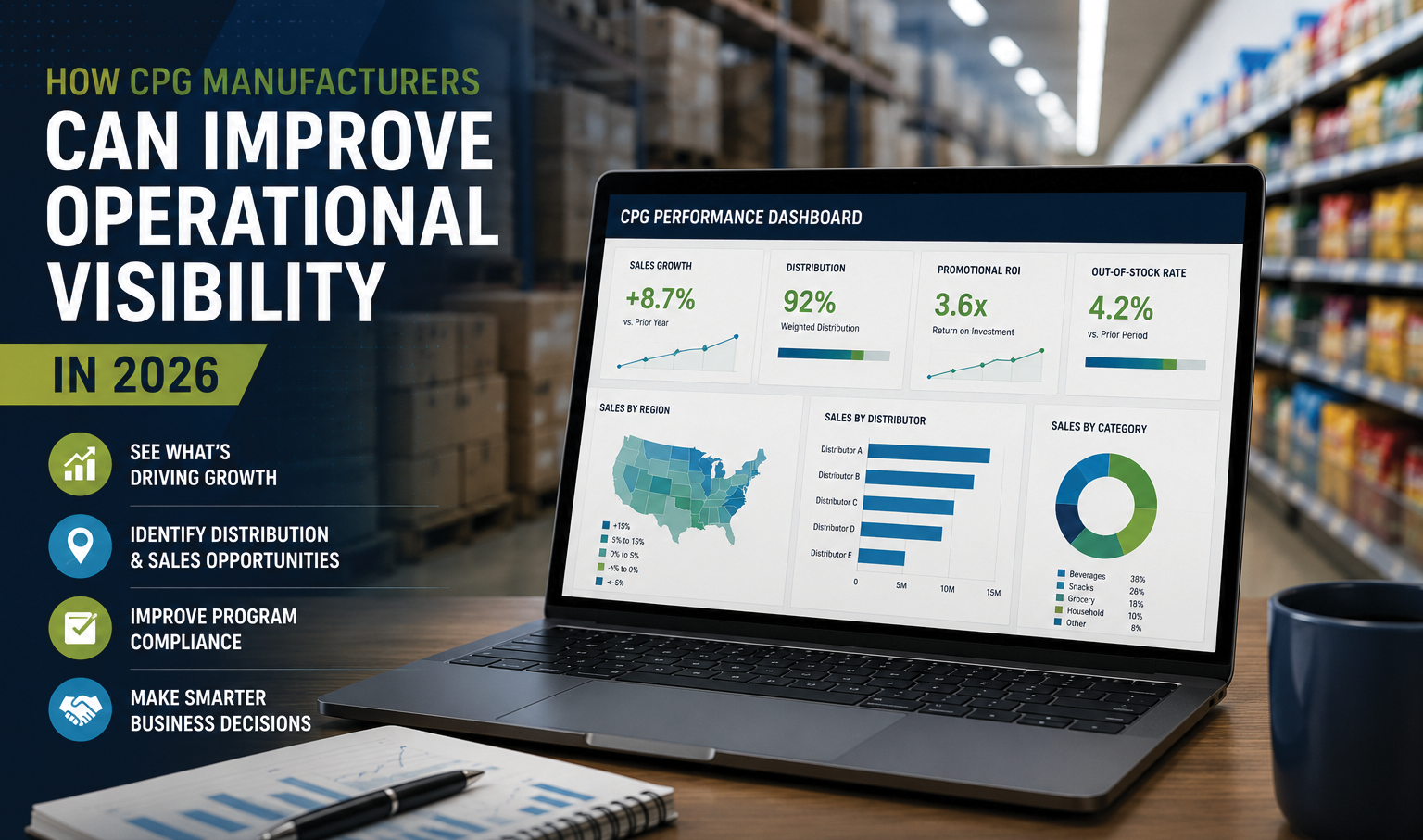
Useful CPG performance metrics can include:
- Sales growth
- Unit volume
- Product velocity
- Distribution percentage
- Distribution growth
- Sales by distributor
- Sales by retailer
- Sales by store
- Promotional ROI
- Trade program compliance
- Product voids
- Out-of-stock trends
The most effective dashboards make it easy to identify exceptions and opportunities rather than forcing users to search through unnecessary information.
For additional guidance, read What Every CPG KPI Dashboard Should Measure in 2026.
Turn Operational Data Into Business Intelligence
Visibility becomes valuable when it leads to action.
Consider the difference between these three stages:
Data: Sales for a product declined 8%.
Insight: Most of the decline came from a specific group of retail locations.
Action: Investigate distribution, availability, pricing, or program execution at those locations.
This progression from data to insight to action is at the center of effective CPG business intelligence.
Instead of asking teams to interpret thousands of individual transactions, business intelligence should help surface the opportunities and exceptions that deserve attention.
Read How Business Intelligence Improves CPG Performance in 2026 for a deeper look at this approach.
Improve Collaboration With Distributors and Retailers
Operational visibility also improves conversations between trading partners.
When manufacturers, distributors, and retailers can discuss measurable performance, business reviews become more productive.
Instead of relying on assumptions, teams can focus on:
- Sales results
- Distribution opportunities
- Retail execution
- Promotion performance
- Compliance
- Category trends
- Growth opportunities
Shared visibility creates a clearer foundation for collaboration and accountability.
For more on retailer collaboration, visit How CPG Suppliers Can Improve Retailer Relationships in 2026.
Best Practices for Improving CPG Operational Visibility
Standardize Your KPIs
Teams should use consistent definitions for important metrics so that sales, management, and trading partners are evaluating performance the same way.
Review Data Frequently
Fast-moving retail conditions make outdated information less actionable. Regular performance reviews allow teams to respond sooner.
Analyze Beyond Aggregate Results
National or chain-level totals are useful, but store, retailer, distributor, product, and geographic views often reveal the real opportunities.
Prioritize Exceptions
Focus attention on unusual changes, underperformance, distribution gaps, compliance issues, and emerging growth.
Compare Current and Historical Performance
Historical context makes it easier to distinguish meaningful trends from temporary fluctuations.
Connect Insights to Actions
Every important KPI should ultimately support a business decision.
Frequently Asked Questions About CPG Operational Visibility
What is operational visibility in CPG?
Operational visibility is the ability to understand sales and performance across products, distributors, retailers, stores, geographic markets, trade programs, and other areas that influence a CPG manufacturer’s business.
Why is store-level sales data important for CPG manufacturers?
Store-level data helps manufacturers identify performance differences that may be hidden by aggregate reporting. It can reveal product voids, distribution opportunities, underperforming locations, and potential availability issues.
How can CPG manufacturers identify distribution opportunities?
Manufacturers can compare product distribution and sales performance across stores, retailers, distributors, and markets to identify locations where successful products may have additional placement potential.
What KPIs should CPG manufacturers track?
Useful KPIs include sales growth, unit volume, product velocity, distribution, distributor performance, retailer performance, store-level sales, promotional ROI, trade program compliance, product voids, and out-of-stock trends.
How does historical data improve operational visibility?
Historical data provides context for current performance. It helps manufacturers identify seasonal patterns, long-term trends, recurring promotional results, and meaningful changes in sales behavior.
How does business intelligence improve CPG visibility?
Business intelligence organizes sales and performance information into actionable insights, helping teams identify opportunities, exceptions, trends, and areas requiring attention.
Can operational visibility improve distributor and retailer relationships?
Yes. Shared performance information provides manufacturers, distributors, and retailers with a common foundation for discussing results, identifying opportunities, and establishing measurable objectives.
Looking Ahead
CPG manufacturers do not need more disconnected information. They need clearer visibility into the information that can influence their next decision.
Store-level sales, distributor performance, retail execution, historical trends, trade programs, and product distribution each tell part of the story.
Bringing those perspectives together gives manufacturers a clearer understanding of where performance is strong, where opportunities are being missed, and where teams should take action.
In an increasingly data-driven CPG marketplace, operational visibility is becoming an important competitive advantage.
For more insights on CPG analytics, trade programs, retailer performance, and data-driven decision-making, visit the InfoBate News Center.