Trade programs remain one of the most effective ways for consumer packaged goods (CPG) manufacturers and suppliers to drive sales, strengthen retailer partnerships, and increase market visibility. However, even the best-designed trade promotion can fall short when execution does not match expectations.
In 2026, trade program compliance has become a strategic priority. As retailers demand greater accountability and manufacturers seek stronger returns on promotional investments, organizations are placing more emphasis on ensuring programs are executed accurately, consistently, and according to agreed-upon terms.
Companies that prioritize compliance can reduce financial risk, improve retailer trust, strengthen promotional effectiveness, and build more productive long-term partnerships.
What Is Trade Program Compliance?
Trade program compliance refers to the process of confirming that promotional agreements, pricing, merchandising requirements, retailer commitments, and performance conditions are executed as planned.
Trade program compliance may include monitoring:
- Promotion execution
- Retail pricing
- Display compliance
- Product placement
- Promotional timing
- Retailer participation
- Performance reporting
- Contract adherence
- Claims and deductions
Effective compliance monitoring helps CPG manufacturers and suppliers confirm that trade investments are producing the intended results.
Why Trade Program Compliance Is Becoming More Important
Today’s retail environment is increasingly competitive and performance-driven. Manufacturers are investing substantial resources in promotions, retailer incentives, category growth initiatives, and trade spend optimization.
Without effective compliance processes, organizations may struggle to determine whether retailers completed the activities required under a trade agreement.
Improved trade program compliance supports:
- More consistent promotional execution
- Greater retailer accountability
- Reduced financial and operational risk
- Higher promotional return on investment
- Stronger retailer collaboration
- Better visibility into program performance
- More accurate claims and deductions
Common Trade Program Compliance Challenges
Many CPG manufacturers and suppliers encounter similar obstacles when monitoring trade program execution.
Inconsistent Promotion Execution
Promotions may launch late, displays may be installed incorrectly, products may be placed in the wrong locations, or pricing may vary across stores. These inconsistencies can reduce the effectiveness of an otherwise well-designed promotion.
Limited Visibility
Without timely performance reporting, organizations may not identify compliance issues until after a promotion has ended. This makes it difficult to correct problems while the program is still active.
Manual Verification Processes
Many organizations still rely on spreadsheets, emails, and manual audits. These processes can be time-consuming, difficult to scale, and vulnerable to reporting errors.
Communication Gaps
Miscommunication between CPG suppliers, retailers, brokers, distributors, and field teams can lead to inconsistent expectations and incomplete execution.
Inaccurate Claims and Deductions
When program terms or execution records are unclear, suppliers may face inaccurate claims, deductions, or disputes that consume time and affect profitability.
Key Trade Program Compliance KPIs
Successful CPG organizations monitor compliance through clearly defined key performance indicators. These metrics help teams identify execution gaps, compare retailer performance, and improve future planning.
Important trade program compliance KPIs include:
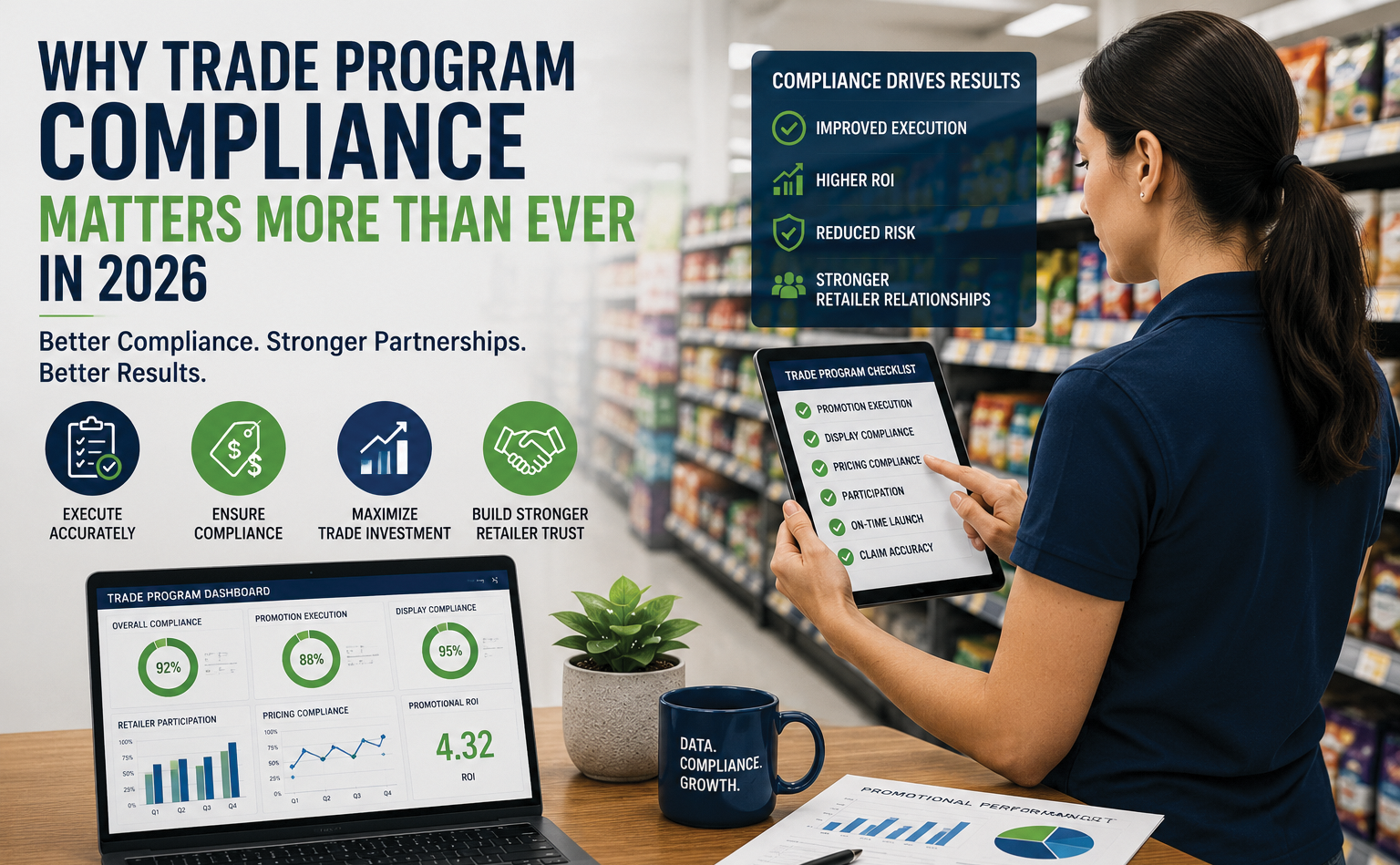
- Promotion execution rate: The percentage of planned promotions executed correctly.
- Retailer participation rate: The percentage of eligible retailers participating in the program.
- Display compliance: The percentage of stores meeting agreed-upon display requirements.
- Pricing compliance: The percentage of locations using approved promotional pricing.
- On-time launch rate: The percentage of promotions launched by the scheduled date.
- Claim accuracy: The percentage of claims supported by accurate documentation.
- Deduction resolution time: The average time required to investigate and resolve deductions.
- Retail audit score: A performance score based on store-level execution.
- Promotional ROI: The financial return generated by the trade investment.
For a broader overview of the metrics CPG teams should monitor, read What Every CPG KPI Dashboard Should Measure in 2026.
Why Business Intelligence Improves Compliance
Business intelligence helps organizations move beyond fragmented reports and manual compliance reviews. Centralized dashboards can make it easier to monitor trade activity, compare retailer performance, and identify problems before they significantly affect results.
CPG business intelligence can provide visibility into:
- Retail execution
- Promotional performance
- Compliance trends
- Retailer scorecards
- Historical program results
- Claims and deduction activity
- Trade spend performance
These insights support more informed decisions and help teams continuously improve trade program planning.
Learn more in How Business Intelligence Improves CPG Performance in 2026.
How Compliance Strengthens Retailer Relationships
Trade program compliance is not only about monitoring activity. It also helps build trust between suppliers and retailers.
Retailers value suppliers that communicate clearly, provide accurate reporting, execute consistently, and support shared business objectives. When both parties have visibility into program expectations and results, collaboration becomes more productive.
Strong compliance processes can support:
- Better retailer partnerships
- More productive business reviews
- Improved category planning
- More promotional opportunities
- Greater accountability
- Long-term growth
For additional strategies, read How CPG Suppliers Can Improve Retailer Relationships in 2026.
Best Practices for Improving Trade Program Compliance
Establish Clear Program Requirements
Document promotional objectives, pricing, display requirements, timelines, responsibilities, and performance expectations before the program begins.
Standardize Compliance Reporting
Use consistent reporting methods across retailers, regions, and programs. Standardization makes it easier to compare results and identify recurring issues.
Monitor Performance During the Promotion
Do not wait until the program ends to review compliance. Monitoring active promotions allows teams to address execution issues while there is still time to improve results.
Use Historical Data
Past program results can help organizations identify patterns, compare retailer performance, and improve future trade promotion planning.
Conduct Regular Retailer Reviews
Review execution rates, promotional ROI, retailer participation, and compliance trends with retail partners on a regular basis.
Connect Compliance to Trade Promotion Effectiveness
Compliance metrics should be evaluated alongside sales lift, profitability, trade spend, and retailer performance.
Read Measuring Trade Promotion Effectiveness: The KPIs Every CPG Team Should Track in 2026 for more guidance.
Frequently Asked Questions About Trade Program Compliance
What is trade program compliance?
Trade program compliance is the process of confirming that promotional agreements, pricing requirements, merchandising activities, retailer commitments, and performance conditions are executed according to plan.
Why is trade program compliance important?
Trade program compliance helps CPG manufacturers and suppliers improve promotional ROI, reduce financial risk, strengthen retailer relationships, and ensure trade investments are executed properly.
What KPIs should be used to measure trade program compliance?
Common KPIs include promotion execution rate, retailer participation, display compliance, pricing compliance, on-time launch rate, claim accuracy, deduction resolution time, retail audit scores, and promotional ROI.
How does business intelligence improve compliance?
Business intelligence provides clearer visibility into promotional performance, retailer execution, historical trends, claims, deductions, and compliance results. This helps teams identify issues sooner and make more informed decisions.
How can CPG suppliers improve retailer compliance?
Suppliers can improve compliance by establishing clear expectations, standardizing reporting, monitoring active promotions, reviewing KPIs regularly, and communicating consistently with retailers and field teams.
What is the connection between trade compliance and promotional ROI?
A promotion is less likely to deliver its expected return when pricing, displays, participation, or timing requirements are not followed. Stronger compliance helps protect trade investments and improve promotional ROI.
How often should trade program compliance be reviewed?
Compliance should be monitored throughout the promotion and reviewed again after completion. Ongoing monitoring allows teams to correct execution issues before they negatively affect the final results.
Looking Ahead
Trade program compliance will continue to play an important role in helping CPG manufacturers and suppliers maximize promotional investments in 2026 and beyond.
Organizations that prioritize visibility, accountability, retailer collaboration, and continuous improvement will be better positioned to strengthen partnerships, improve promotional effectiveness, and reduce trade-related risk.
As trade programs become more complex, compliance will remain a critical driver of measurable performance and sustainable growth.
Explore more articles on trade promotion, business intelligence, CPG performance, and retailer collaboration in the InfoBate News Center.
“`