Convenience store distribution is changing quickly.
Retailers are expanding their product assortments, consumers expect greater availability and convenience, and CPG suppliers are under growing pressure to deliver the right products to the right locations at the right time.
At the same time, distributors are managing increasingly complex networks of products, retailers, promotions, store locations, and sales data.
For CPG manufacturers, suppliers, distributors, and convenience retailers, these changes are creating new opportunities to improve distribution, strengthen collaboration, and make better use of data.
Here are seven convenience store distribution trends businesses should be watching as 2026 progresses and the industry prepares for 2027.
1. Store-Level Data Is Becoming More Important
Traditional distribution reporting often focuses on broad metrics such as total sales by retailer, distributor, territory, or product.
Those measurements remain important, but store-level data can reveal opportunities that aggregate reporting may miss.
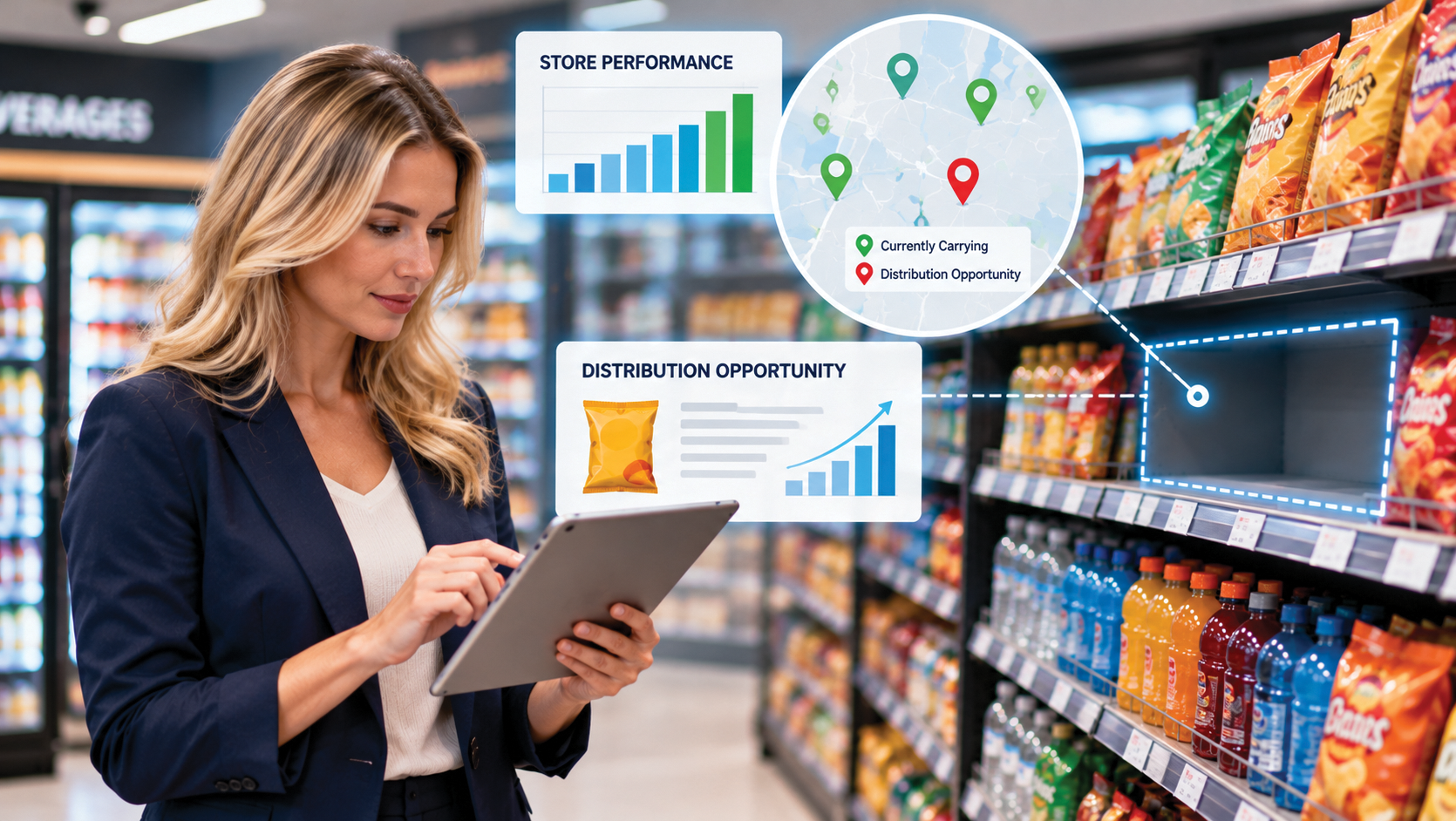
Consider a product with strong sales across a convenience store chain. Chain-wide results may look positive, while individual store analysis could reveal that the product is performing exceptionally well in some locations but is unavailable in similar stores nearby.
That information can help CPG suppliers identify:
- Product distribution gaps
- High-performing locations
- Underperforming stores
- Regional opportunities
- Potential product voids
- New placement opportunities
The future of convenience store distribution will increasingly depend on understanding not only how much product is moving, but exactly where it is moving.
For more on store-level analytics, read How Convenience Stores Are Using Data to Improve Profitability in 2026.
2. Product Availability Will Become a Bigger Competitive Advantage
Consumers expect convenience stores to have the products they want when they visit.
When an item is unavailable, the impact can extend beyond a single lost sale. Customers may substitute another brand, choose another store, or change their purchasing habits.
Improving product availability requires greater visibility into:
- Store-level sales
- Distribution
- Product velocity
- Out-of-stock patterns
- Retailer performance
- Distributor performance
Manufacturers and distributors that can identify availability problems earlier have a better opportunity to address them before they become persistent sales issues.
3. Distribution Strategies Will Become More Data-Driven
Experience and retailer relationships will always matter in convenience distribution.
Data is increasingly adding another layer to those decisions.
Instead of broadly expanding distribution, suppliers can use sales and performance data to determine where additional placement is most likely to generate results.
For example, teams can compare similar stores based on:
- Geography
- Category performance
- Product velocity
- Retailer type
- Historical sales
- Existing assortment
If a product performs strongly across a group of similar stores but is missing from several comparable locations, those stores may represent high-priority distribution opportunities.
This creates a more targeted approach to growth.
4. Distributor Performance Visibility Will Improve
CPG manufacturers frequently work with multiple distributors across different territories, customers, and product categories.
Understanding distributor performance is therefore essential.
Rather than looking only at total sales, manufacturers can evaluate distributors across metrics such as:
- Sales growth
- Distribution growth
- Product mix
- Retail coverage
- Customer performance
- Trade program participation
- Geographic performance
The objective is not simply to rank distributors.
Better visibility can help manufacturers understand where individual distributors are succeeding and where additional sales or distribution opportunities exist.
These insights can also make distributor reviews more productive by giving both parties measurable performance information to discuss.
5. Trade Promotions Will Become More Closely Connected to Distribution
Trade promotion and distribution should not operate as separate strategies.
Promotions can increase consumer demand, but their effectiveness may be limited if product distribution and availability are inconsistent.
Future trade promotion analysis will increasingly consider:
- Where promoted products are distributed
- Which retailers participated
- Which stores executed the promotion
- Whether products remained available
- How sales changed during the promotion
- Whether distribution increased afterward
Connecting promotion performance with distribution information creates a more complete understanding of program effectiveness.
Read Measuring Trade Promotion Effectiveness: The KPIs Every CPG Team Should Track in 2026 for additional strategies.
6. Retailer, Supplier, and Distributor Collaboration Will Become More Data-Driven
Convenience store distribution depends on strong relationships among retailers, distributors, manufacturers, and suppliers.
Data can make those relationships more productive.
Instead of relying primarily on anecdotal feedback, partners can discuss measurable results such as:
- Sales growth
- Distribution
- Product velocity
- Retailer participation
- Trade program compliance
- Promotional ROI
- Store-level opportunities
Shared performance visibility creates a common foundation for identifying opportunities and establishing priorities.
For CPG suppliers, this can shift retailer conversations from simply selling products toward discussing category performance and mutual growth.
Learn more in How CPG Suppliers Can Improve Retailer Relationships in 2026.
7. Business Intelligence Will Move From Reporting to Opportunity Identification
One of the biggest changes in convenience store distribution will be how organizations use their data.
Traditional reporting answers questions such as:
How much did we sell?
Which distributor generated the most revenue?
Which retailer grew last quarter?
Those questions remain useful, but modern CPG business intelligence can go further.
The next generation of distribution analysis will increasingly focus on questions such as:
Where should this product be distributed next?
Which stores represent the greatest sales opportunity?
Where might an out-of-stock situation be affecting performance?
Which distributors have untapped growth potential?
Which promotions are creating sustainable sales growth?
This represents an important shift from reporting what happened to identifying what teams should do next.
For additional insight, read How CPG Manufacturers Can Improve Operational Visibility in 2026.
The Role of AI in Convenience Store Distribution
Artificial intelligence is also beginning to influence distribution planning.
As organizations accumulate more historical sales, retailer, product, and promotional data, AI can help identify patterns that would be difficult to recognize manually.
Potential applications include:
- Demand forecasting
- Distribution opportunity identification
- Out-of-stock pattern detection
- Product performance analysis
- Retailer segmentation
- Promotion analysis
- Historical trend detection
AI is most valuable when it helps teams interpret reliable data and prioritize opportunities rather than simply generating more information.
What Convenience Store Distributors Should Measure
Organizations preparing for the future should establish a consistent set of distribution KPIs.
Useful measurements may include:
- Sales growth
- Unit volume
- Product velocity
- Weighted distribution
- Distribution growth
- Sales by distributor
- Sales by retailer
- Sales by store
- Product voids
- Out-of-stock trends
- Promotional sales lift
- Trade program compliance
- Retailer participation
A strong KPI framework helps teams identify where performance is improving and where additional attention is needed.
For more guidance, visit What Every CPG KPI Dashboard Should Measure in 2026.
Preparing for the Future of Convenience Store Distribution
CPG manufacturers, suppliers, and distributors do not need to pursue every emerging technology or analytics trend at once.
A practical distribution strategy begins with several fundamentals:
Improve Data Quality
Accurate analysis depends on consistent, reliable information.
Increase Store-Level Visibility
Look beyond chain and distributor totals to understand what is happening at individual locations.
Identify Distribution Gaps
Use performance data to determine where successful products may have additional placement opportunities.
Monitor Product Availability
Pay attention to sales patterns that may indicate availability or execution problems.
Connect Promotions With Distribution
Evaluate whether products were available and properly distributed during promotional programs.
Compare Distributor Performance
Use consistent metrics to understand strengths and opportunities across distributor partners.
Turn Insights Into Actions
Every dashboard or report should ultimately help someone make a better decision.
Frequently Asked Questions About Convenience Store Distribution
What is convenience store distribution?
Convenience store distribution is the process of moving products from manufacturers and suppliers through distributors to convenience retail locations. It includes product availability, assortment, delivery, retailer coverage, sales performance, and distribution planning.
What trends are changing convenience store distribution?
Important trends include increased use of store-level data, greater focus on product availability, data-driven distribution planning, improved distributor performance measurement, closer integration between promotions and distribution, stronger partner collaboration, and increased use of business intelligence.
Why is store-level data important for convenience distribution?
Store-level data helps suppliers and distributors identify differences that can be hidden by chain-wide reporting. It can reveal product voids, underperforming locations, distribution gaps, and potential growth opportunities.
How can CPG suppliers identify distribution opportunities?
Suppliers can compare sales and distribution across similar stores, retailers, regions, and distributors to identify locations where successful products are currently unavailable or underrepresented.
How can data help convenience store distributors?
Data can help distributors monitor sales performance, identify product opportunities, improve retailer coverage, measure program results, and prioritize accounts or locations with the greatest growth potential.
What KPIs should convenience store distributors monitor?
Important KPIs include sales growth, unit volume, product velocity, distribution percentage, distribution growth, store-level sales, product voids, out-of-stock trends, retailer participation, and promotional performance.
How will AI affect convenience store distribution?
AI can help analyze large amounts of historical and current data to improve forecasting, detect performance patterns, identify potential distribution opportunities, and prioritize areas requiring attention.
Looking Ahead
The future of convenience store distribution will be defined by greater visibility, stronger collaboration, and more intelligent use of data.
The organizations positioned to succeed will not necessarily be those with the most information. They will be the organizations that can turn information into clear decisions about products, stores, retailers, distributors, and trade programs.
As convenience retail continues to evolve, CPG manufacturers, suppliers, and distributors have an opportunity to move from broad distribution strategies toward more precise, data-driven approaches.
Better visibility can reveal where products should be placed, where availability needs attention, which partners are driving growth, and which opportunities deserve action.
For more insights on convenience retail, CPG analytics, trade programs, and data-driven decision-making, visit the InfoBate News Center.